
-

-
Date June 17, 2026
Traditional Publishing vs Self-Publishing: Which Is Right for You?
Selecting between the two options, whether to self-publish or opt for traditional publishing, requires a strategic approach.
Many writers consider Professional Book Publishing Services pivotal to that decision-making, because the real concern is not “who prints the book?” but “which path enables the book to reach readers, gain credibility, and generate revenue?” The response is directly correlated with your goals, budget, timeline, and the workload you are ready to retain in your own hands.
Table of Contents
Traditional Publishing VS Self-Publishing
Traditional publishing is the old school: a publisher first chooses the manuscript, then makes an advance payment to the writer, manages editorial and production tasks, and takes on distribution responsibilities and much of the commercial risk. Self-publishing spins this model.
The author assumes the publisher role solely, either by managing the entire process directly or by outsourcing it to service providers. This gives the author far more authority over pricing plans, timing-related targets, and documentation + intellectual rights.
Therefore, the comparison is significant for decision-making: traditional publishing trades control for support, whereas self-publishing trades support for ownership.
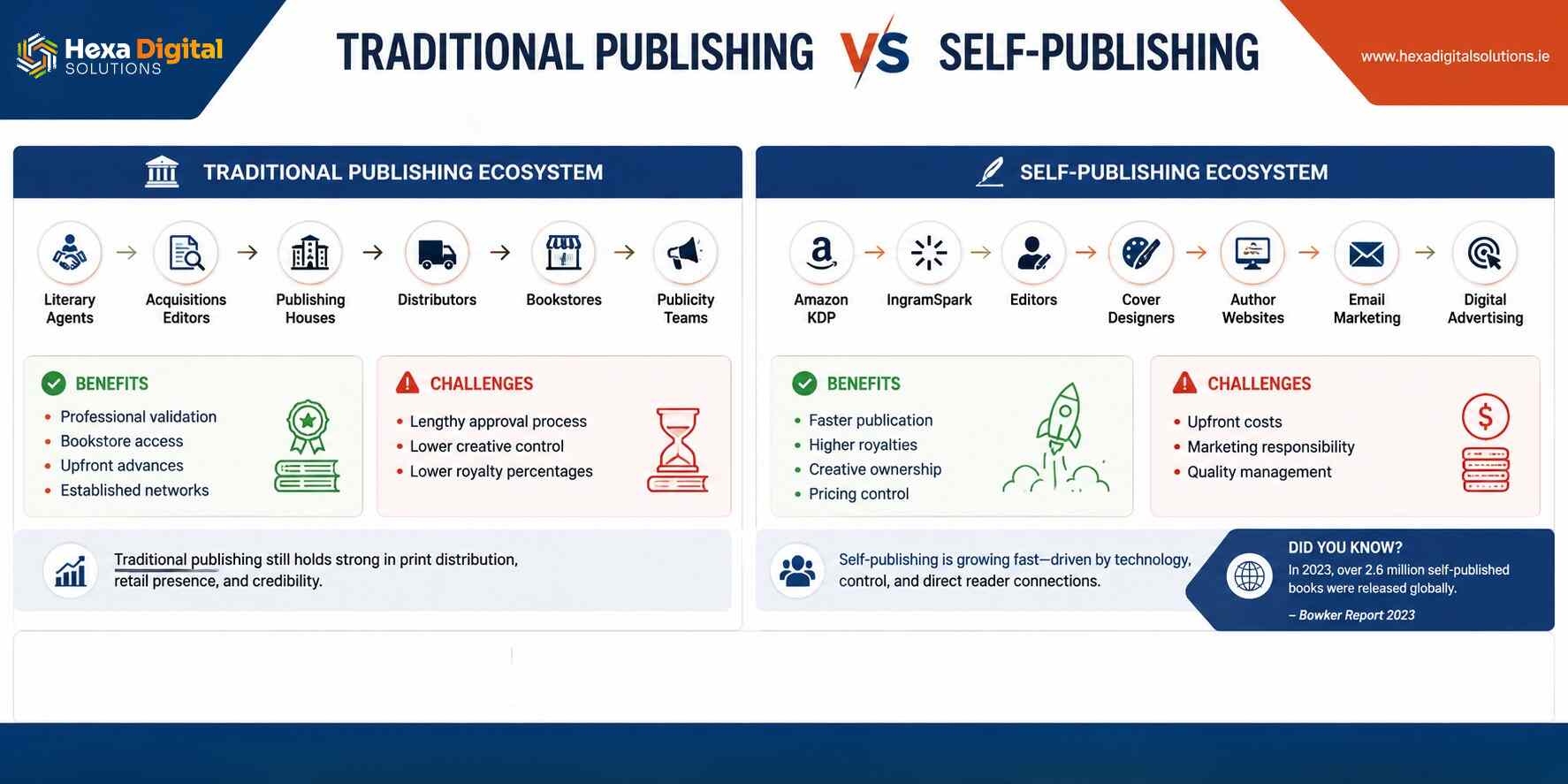
Choosing Between Self-Publishing & Traditional Publishing
Publishing is happening at a much faster rate, which, in turn, is fragmenting readers at almost the same pace. More than 2.6 million books were self-published in 2023, a major portion through Amazon’s Kindle Direct Publishing ecosystem.
This validates the large share claimed by the independent market. Simultaneously, a 2023 survey published in The Guardian, based on input from 2,000 self-published authors, revealed that almost half earned more than USD 20,000 in revenue, and 28% earned more than USD 50,000.
This further reinforces that self-publishing is no longer the “fallback” option people once overlooked. The old gatekeeper model, that is, traditional publishing, still prevails, but the landscape has changed from all directions.
In light of changes in market trends and insights, traditional publishing has also adapted to greater flexibility. According to Reuters, Bloomsbury’s recent results were boosted by strong demand for fiction amplified by TikTok and Instagram.
A separate Amazon supply negotiation revealed how even major publishers remain tightly reliant on platform access and distribution deals. In other words, publishing success now depends on both editorial quality and market visibility.
Which Path Is Best For Which Author?
Traditional publishing is more beneficial when the writer is looking for editorial support, reliable retailers, and high-reach distribution channels – particularly for types of books that require physical presence at bookstores, media pitching, or a strong brand halo.
On the other hand, self-publishing often complements authors who require speed, creative control, higher per-copy margins, and the ability to react quickly to market demand.
The trade-off is straightforward: self-publishing allows you to enjoy freedom and authority, but it also passes the full financial and creative workload.
Here is where the comparison offers practical implications. For those authors comparing the Top Book Publishing Companies in Ireland you should know or shortlist the Top 7 Book Publishing Companies in Ireland – the smartest strategy would be to look beyond prestige.
It is recommended that writers critically dissect the offer in terms of editing support, rights terms, distribution reach, and the extent of marketing support that would actually be provided. These should be the core deciding factors.
The same logic shall be applied to Irish Book Publishing Trends Author’s Need to Know: platform access, reader discovery, and speed, which are the main variables driving the publishing equation.
The Challenge vs. The Apt Response
The most common miscalculation by authors is assuming that the publishing model will handle marketing as well. In reality, it will not. Traditional publishing might provide direction, but it can’t guarantee complete reach to readers.
Self-publishing might accelerate the marketing process, but without design, editing, and promotion, the book may become part of the clutter. This signals the core Book Publishing Challenges and How to Overcome Them.
The apt response would be to treat the book like a product and the writer like a brand. Professional editing, a well-designed cover, high-quality metadata, and a proper strategic launch plan are equally significant in the case of both models.
Then, there are challenges emerging on technological fronts due to advancements in AI and shifts in expectations. Reuters and The Guardian both confirm that the publishing market is under immense pressure to maintain a certain pace and stay human.
To overcome these challenges, Microsoft’s new imprint was created to expedite the traditional publishing cycle, while a new “organic literature” certification has also been introduced to differentiate human-written books from AI-generated content.
This indicates where the market is being directed: efficient workflows, enhanced automation, and additional value placed on authenticity and originality.
Role and Relevance Of Hexa Digital Solutions
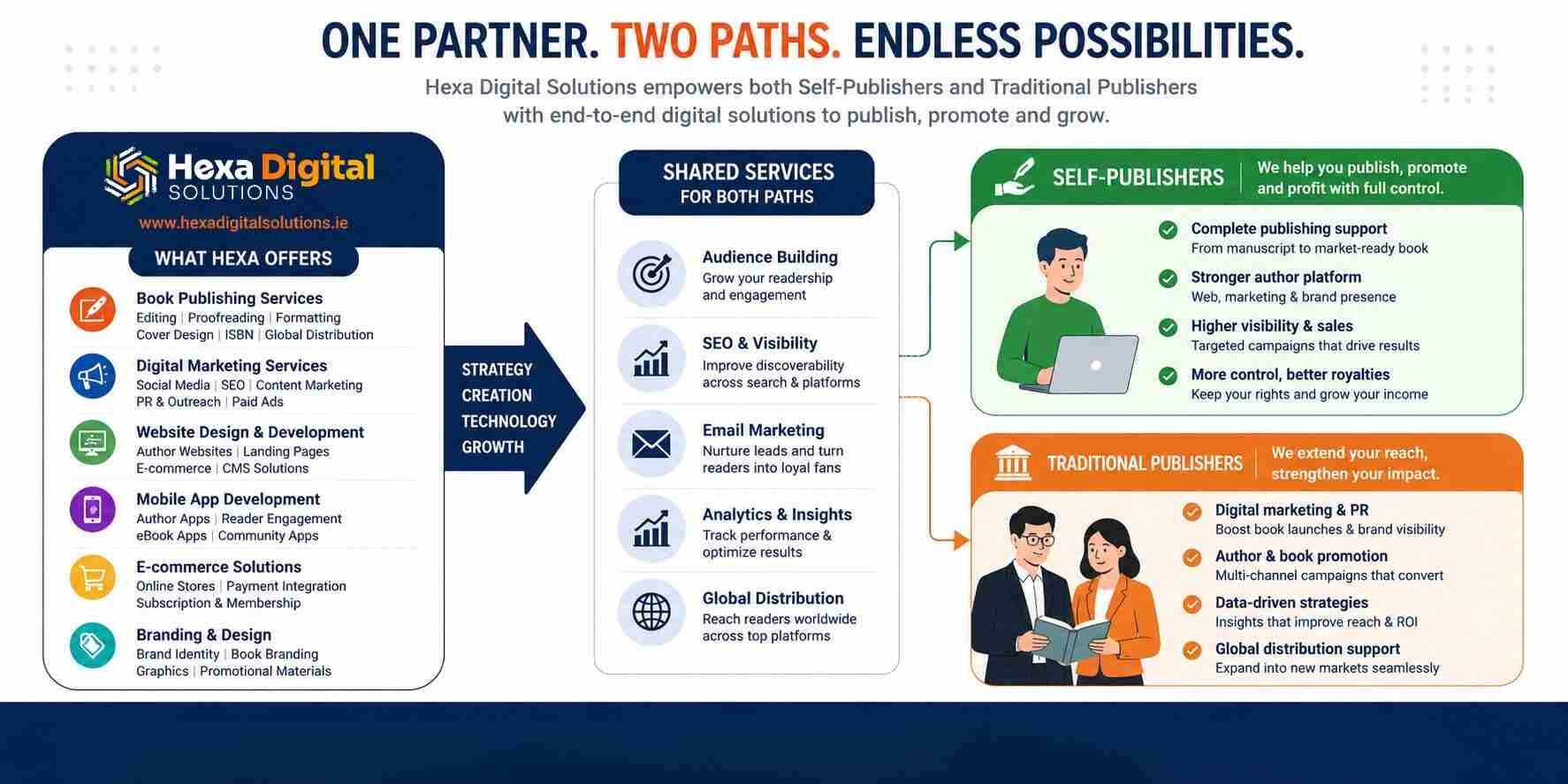
The current market trends for both types of publishing make Hexa Digital Solutions’ role more relevant in the ongoing, evolving era. Based in Dublin, Hexa already offers services across digital marketing, branding, mobile apps, e-commerce, and content-driven growth.
For writers, it is advisable to seriously consider such service providers because publishing alone is only half the job. The remaining half is discoverability.
A strong author website, smart SEO, email capture, launch campaigns, and social content can demarcate between a book that silently rests on a shelf or some online space and a book that actually sells.
That is also where website design and development services, Ireland digital marketing services, and even Ireland mobile app development services can provide backing to an author brand that aspires to grow beyond a single title.
Hexa’s Professional Book Publishing Services are very helpful for writers who wish to achieve targets more than just file conversion. Editing manuscripts, proofreading, cover design, formatting, ISBN registration, and global distribution are areas that provide maximum benefit only when integrated into a broader visibility strategy.
We can call it the practical edge: not just publishing the book, but supporting it so it gets found, trusted, and bought.
Final Verdict
We can’t declare a universal winner in the contest between traditional publishing and self-publishing. Traditional publishing is best for writers who value support, validation, and retail reach. Self-publishing is best for writers who value speed, ownership, and higher upside.
The actual deciding factor shall not be “which model is better?” but which one best aligns with your plans, resources, and growth goals. Pick the path that pushes your book to travel, not just to be stationed. The role of Professional Book Publishing Services is to make that journey smarter, not messier.