-

-
Date June 19, 2026
Brand Guidelines Explained: Why Every Growing Business Needs Them
When a business starts growing, inconsistency creeps in fast. Different teams start working on entirely different objectives with no coordination. One team uses a different logo, the other writes in a different tone, and gradually, the company’s main theme starts to scatter.
The website no longer feels the same to the audience as it did when they first saw it in social posts or ads. This is why branding design services become relevant: brand guidelines turn scattered output into a system that people recognize, trust, and connect with.
Especially in today’s market, where brands get attention across many channels at once, consistency in design is more of a growth asset than just being cosmetic or an attractive User Interface [UI].
Table of Contents
Brand Guidelines Explained
Brand guidelines are the rules that define how a business should look, sound, and behave at every touchpoint. They usually cover the visual identity, the brand voice, and the dos and don’ts that keep the whole system coherent.
If the process is done properly, it prevents the brand from becoming an unorganized collection of assets and instead makes it easier for companies and shareholders to work with it. It helps agencies review a well-maintained brand portfolio.
A practical brand guide usually includes the following elements:
- Logo Usage.
- Color Palette.
- Typography.
- Imagery Style.
- Tone of Voice.
- Messaging Rules.
- Action Plan – based on dos & don’ts.
These are not just for visual appeal but also to enable the brand to scale easily without losing its originality. If any of these things are not kept consistent throughout, the brand may lose its character.
The Actual Guidelines That Keep a Brand Consistent
Brand guidelines are most useful when they focus on the parts the audience uses most. This means covering the parts of the website that are visited most often, for example, the landing page.
Here are a few areas that need to be covered:
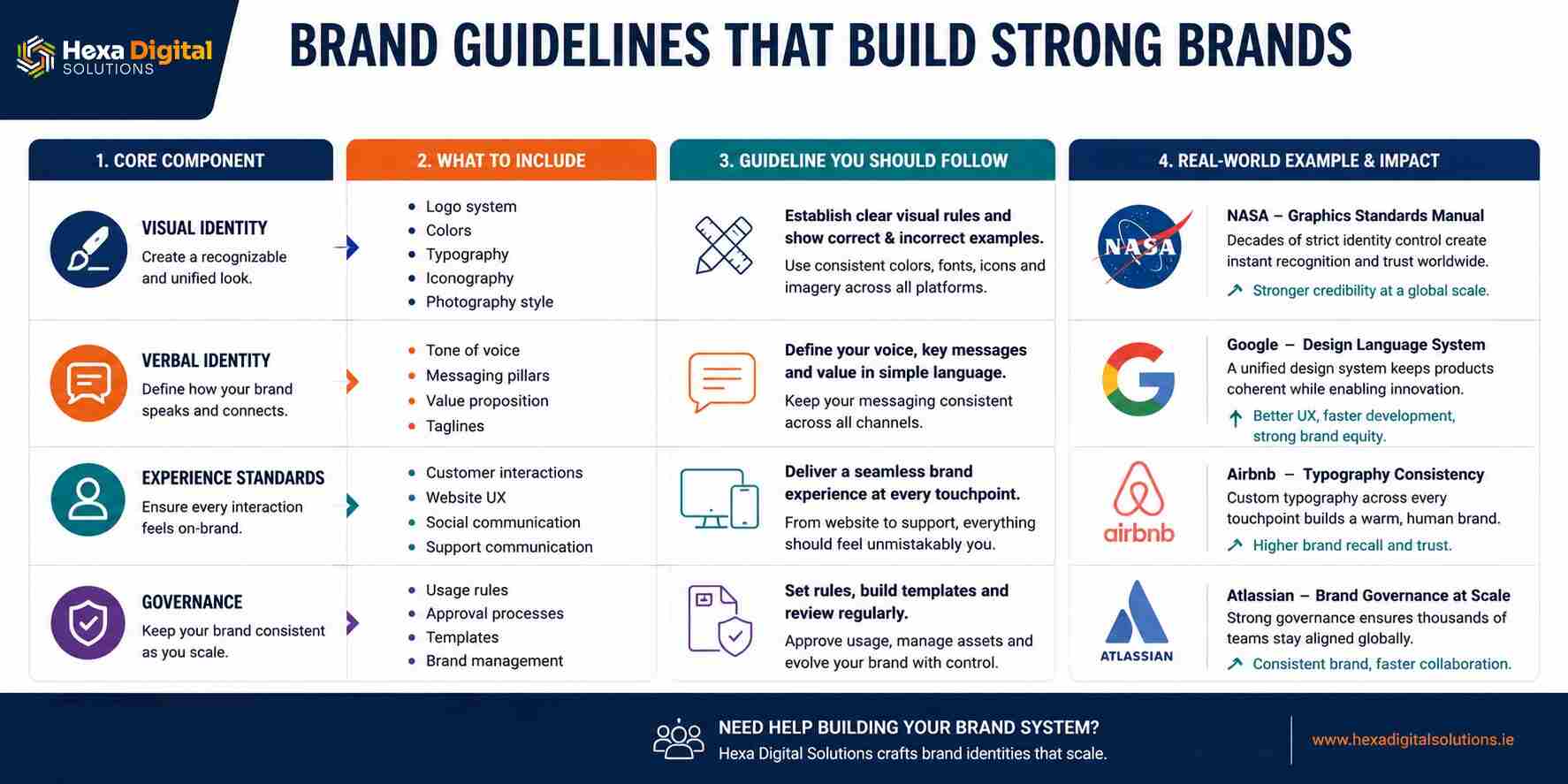
Visual identity: Logo, color, and type rules keep the brand recognizable across ads, websites, and product pages. NASA’s graphics standards manual is still a classic example of strict identity control at scale.
Verbal identity: Tone, messaging, and taglines stop the brand from sounding scattered. The tone should remain consistent in all forms of message conveying, including ads, content, and social media posts. Google’s design language shows how a system can stay coherent across products while still evolving.
Governance: Usage rules, approvals, and templates prevent drift when teams grow. If legal regulations are sorted out earlier in the company, any new people joining the team would feel obliged to follow the same rules. Airbnb’s branding history also shows how a strong typography system helps a brand stay visually consistent across touchpoints.
This is the real job of brand guidelines: to keep the brand sharp and eventually help the business scale.
Growing Businesses First To Face Issues: Why?
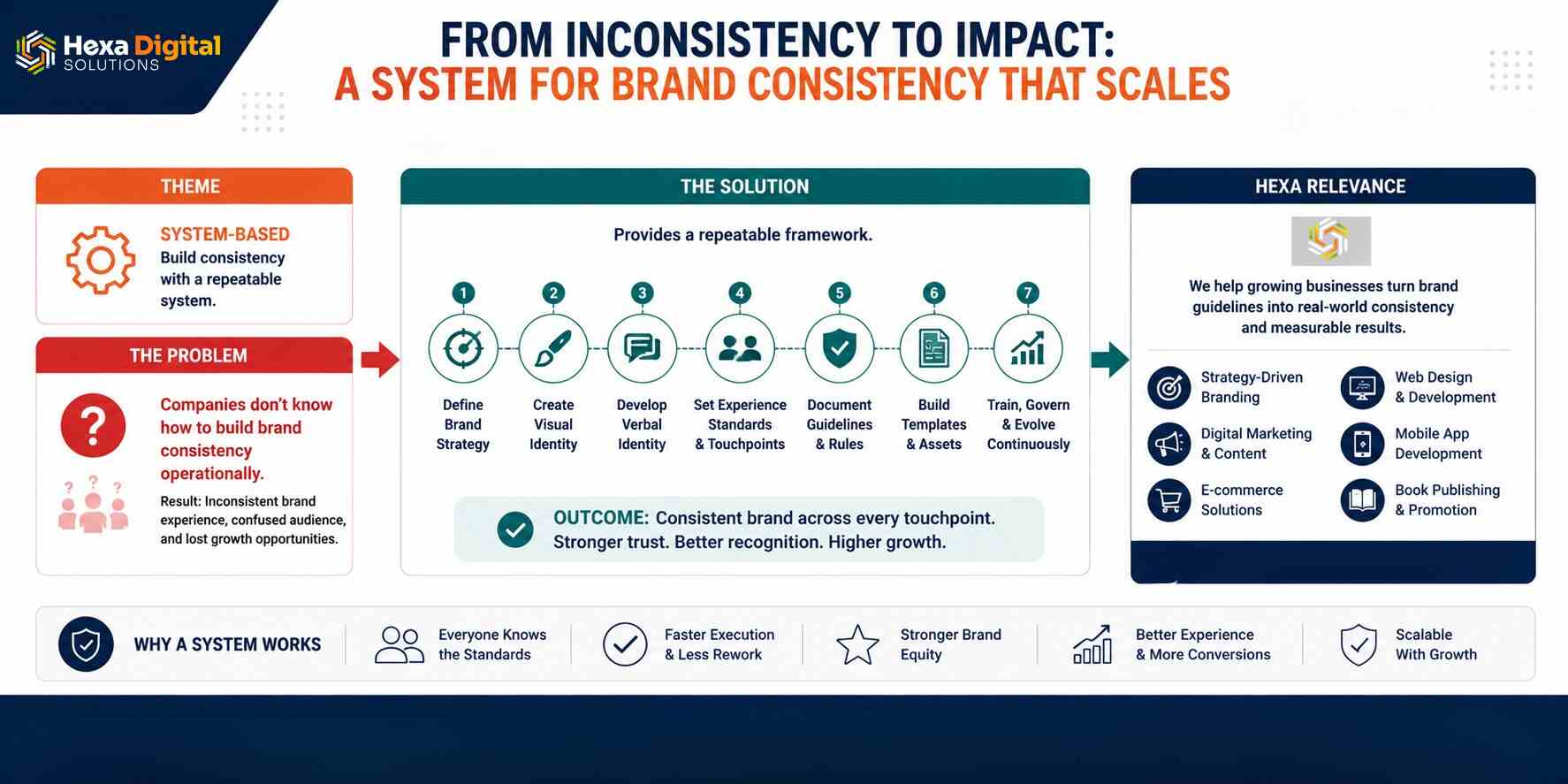
Small businesses can sometimes get away with inconsistency because there are fewer moving parts. The growth of a business usually changes that, as there is now a wider audience to cater to and a much greater responsibility to improve marketing.
While improving marketing, we need to run more campaigns, and at that stage in particular, we have to keep the brand identity consistent; otherwise, the primary audience would lose trust if the branding changes.
Research and industry commentary keep telling us the same strategy: that brands that maintain a clear identity are easier to trust, while brands that drift lose clarity and impact.
WSJ work on social-first brands found stronger revenue growth among brands that use social well and stay cohesive, and branding leaders at TIME100 emphasized that authenticity and consistency deepen trust rather than weaken it.
That is the hidden cost most businesses miss. Weak brand consistency does not just look sloppy. It slows teams down, makes marketing harder to execute, and creates friction in the buying journey. Customers may not say, “Your brand system is broken,” but eventually they’d leave because they would connect with the brand the same way.
Why Branding Design Services Are A Business Asset, Not An Additional Design Cost?
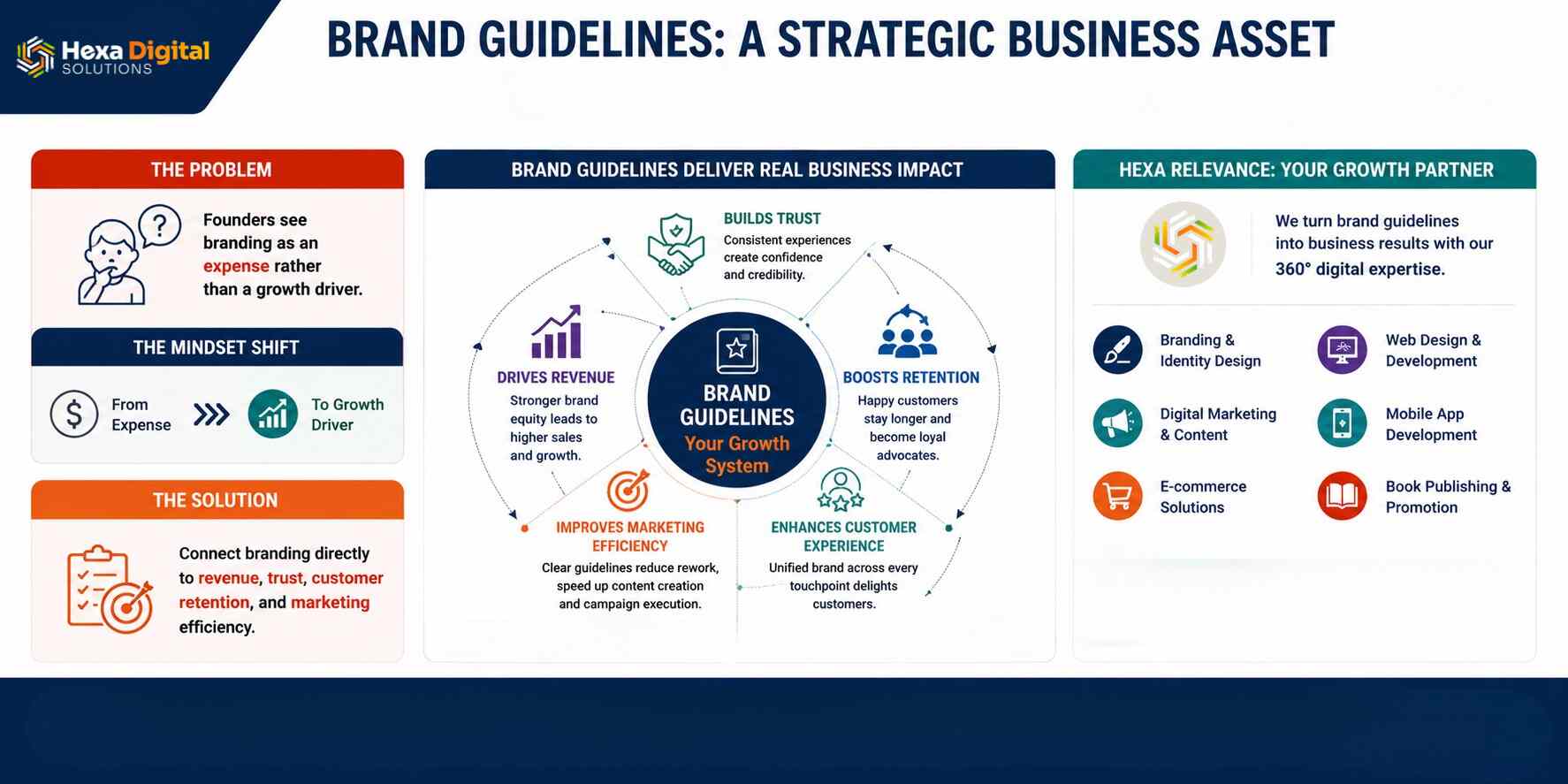
This is where the real value sits. Branding design services help businesses create a usable brand system, not just a prettier logo. That system supports recognition, improves the customer experience, and reduces the time teams waste debating fonts, colors, and wording whenever they launch something new. In other words, brand guidelines improve operational efficiency as much as they improve appearance.
The business case is simple. A clear brand makes it easier for people to identify you, trust you, and buy from you. It also makes your marketing more efficient because every new campaign starts with a defined standard rather than a blank page.
The Times recently noted that strong brands combine values with visibility, and that trust grows when a brand’s promise matches how it behaves in the real world. That is exactly what good guidelines enforce.
Defining The Role Of A Strong Brand System
A useful brand system should provide enough structure for people to move quickly without guessing. It should protect the core identity while still allowing creative execution.
It should make onboarding easier for new team members, simplify handoff between marketing and design, and keep the website, social media, email campaigns, and sales materials aligned.
At Hexa Digital Solutions, that thinking naturally connects branding to broader execution. A consistent identity supports stronger websites, clearer content, better digital campaigns, and more trustworthy user experiences.
That matters whether a business is launching a new site, building an app, or expanding its e-commerce presence. It is also why branding often sits at the center of services like Ireland Digital Marketing Services, Web design Company in Ireland, and Mobile app development services in Ireland, rather than living off in a separate design folder no one opens.
Impact of AI on Brand Guidelines
AI makes this debate more interesting. As content volume increases, the risk of off-brand output increases as well. Adobe’s recent brand-intelligence direction sheds light on where the industry is heading: more automation, but also more need for structured brand standards that machines can follow and teams can enforce.
Adobe’s font and intent research also shows that even something as basic as type selection is now being systemized to improve consistency and speed.
However, brands need to understand that although AI can produce more content, it cannot decide what your brand stands for. AI cannot imitate your originality or your strategies.
Even though AI is seen as a highly trained machine, it cannot help you with external factors that may affect the business, as they are very geographical and vary from place to place. Businesses that ignore this gap end up producing more content and far less clarity and originality.
Brand Guidelines And Business Growth
Brand guidelines support the bigger commercial goals: stronger recognition, better engagement, higher trust, and more efficient conversion. They help a growing company appear established before it is large and coherent while it is scaling. They also make it easier to protect quality across marketing, sales, product, and customer support.
That is why this conversation sits naturally beside Complete Guide To Branding For Irish Businesses In 2026, How To Build A Memorable Brand Identity From Scratch, and Content Writing vs Copywriting: What Your Brand Really Needs.
It also explains why brands choose Hexa Digital Solutions for custom eCommerce portals. The question of why belongs in the same strategic dialogue: once a business starts selling online, the brand has to perform consistently across the storefront, the content, and the customer journey.
For a company like Hexa Digital Solutions, branding is not just a service line; it is the connective tissue that helps every other digital asset work harder.
Conclusion
In conclusion, growing businesses do not need more assets; rather, they need a coherent system that aligns their messaging, visuals, and customer experience. This is the real reason why every brand should consider Branding Design Services: they help the brand maintain consistency, making it easier to scale and build a deep connection with its audience.
It is recommended to start using brand guidelines to understand the science behind your brand and help improve it.