-

-
Date June 12, 2026
Brand Identity vs Brand Image: What Irish Businesses Need to Know
Irish businesses operate in an environment where customers remain invested and aware of their purchase decisions: they are quick to judge, consistent in comparison, and cautious in building trust. Digital habits are deeply ingrained in their buying behavior.
This suggests that first impressions are created when customers visit websites, search results, read reviews, and absorb social content – long before a sale happens. In such markets, brand positioning experts Ireland have become the need of the hour.
Companies like Hexa Digital Solutions have become more relevant than ever because they help businesses close the gap between what is claimed on brands’ end and what is actually perceived by customers. This gap is the difference between identity and image.
Table of Contents
Brand Identity vs Brand Image: The Difference That Drives Growth
Brand identity is what a business intentionally creates for itself: its visuals, voice, values, messaging, and positioning. Brand image is the perception customers conceive after their interaction with the business.
To state it simply, identity is the plan from the business end; image is the verdict from the customer end. Adobe describes a brand as more than just a logo, encompassing the visual appeal and aesthetic choices that shape public perception, while HubSpot similarly defines brand identity as the personality and values a company communicates.
For Irish businesses, this difference is significant because customers are not judging one touchpoint in isolation.
In fact, their verdict is derived from their multiple interactions with brands on various fronts. They may come into contact with a brand through Google results, browsing websites, scrolling through social media, and reading reviews to assess a business’s credibility.
If the identity is refined but the image is inconsistent, trust declines. If the image is strong but the identity is confused, growth becomes harder to achieve. That is why The Role of Branding Services in Building a Strong Brand Identity is not limited to cosmetic lip service; it is actually a commercial venture in itself.
A strategic approach to sales and marketing is critical to acquiring and retaining customers, entering new markets, and achieving growth.
Watchlist For Irish Businesses
A simple method to identify the gap between the identity and the image is to ask whether the promise aligns with the experience. A law firm, for instance, may market itself as premium and precise, but if its website is outdated and its tone seems generic, the image falls short of its expected identity.
Similar issues surface in retail, publishing, and professional services. A strong identity would set expectations; a strong image would validate them. When these two work in tandem, businesses reduce friction and improve conversion rates.
Deloitte’s marketing and commerce work confirms that integrated brand and experience design helps create more relevant customer journeys from awareness through loyalty.
The Gap Gets Visible When:
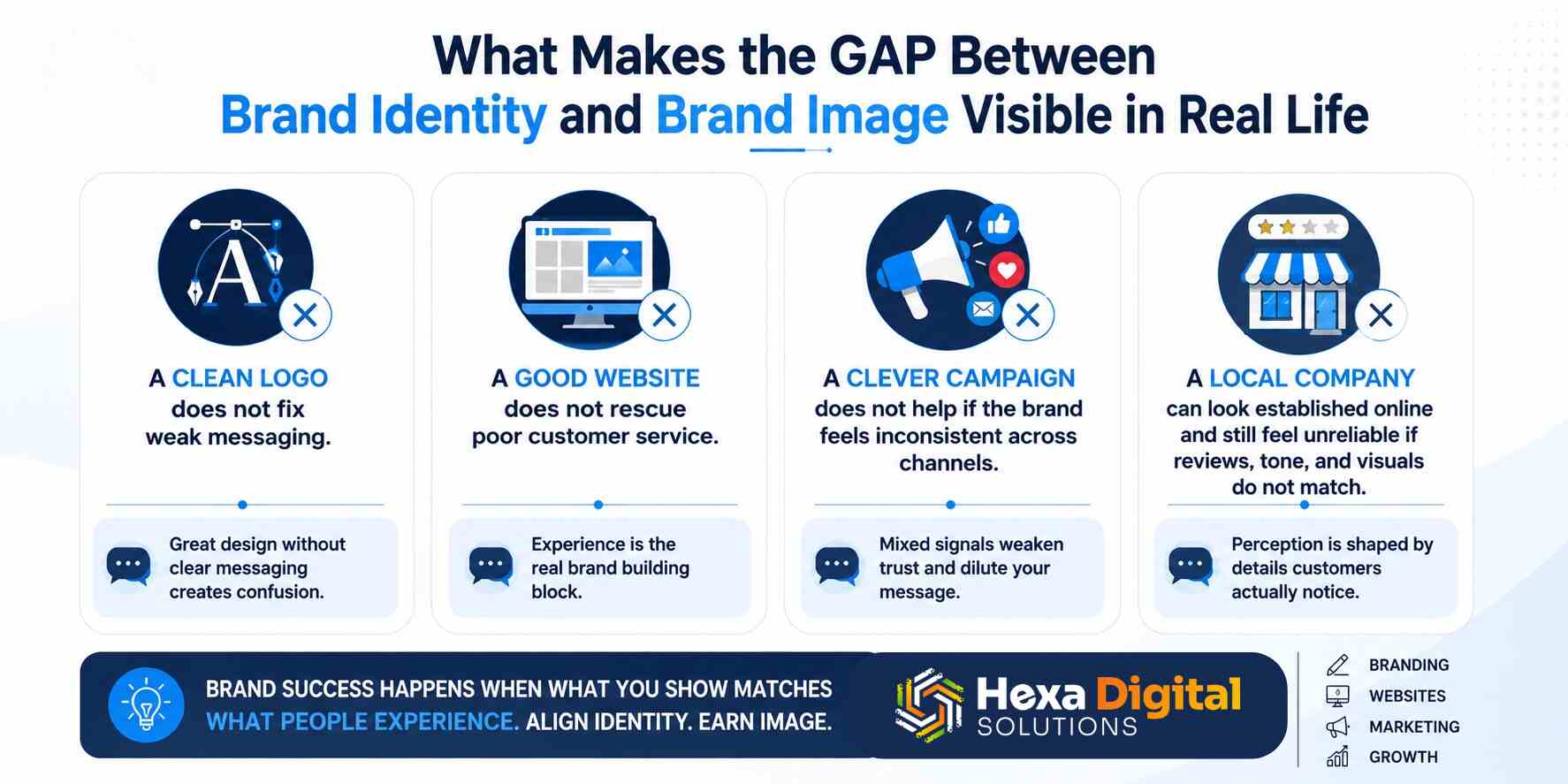
Affordable brand identity services agencies can only be helpful when they perform beyond design files. The task is to achieve alignment, not fancy presentations. For business sectors such as an Accounting and Finance Agency, the goal is to build trust and precision.
For a publisher or ecommerce brand, the task is about ensuring clarity, consistency, and proof. For a startup, it is mostly about establishing credibility in advance.
Digital Branding vs. Traditional Branding: What Works Best In Ireland?
The brief response is both, but digital being more relevant in the current era carries more weight. Ireland’s digital consumer landscape reveals how much routine life, media consumption, and buying behavior have now moved to online spaces, which suggests that a brand’s image now requires continuous online updating and maintenance – no longer dependent on just offline assets.
But we can’t entirely write off the relevance of traditional branding, as physical presence, printed materials, events, and word-of-mouth all contribute to building trust in a brand.
Digital branding undeniably now has more responsibilities because that is where customers research, compare, and validate businesses. The smartest Irish companies blend both approaches.
A local business can use traditional branding to reinforce stability and digital channels to establish relevance. This hybrid approach is usually stronger and more fruitful than relying on one approach.
How To Align Identity And Image Without Overspending?
The most practical path to Transform Your Brand Image with Expert Branding Services starts with a transparent audit. Take a deep, insightful look at your website, social channels, messaging, reviews, and customer journey together.
If the tone, visuals, and promises do not match, the market will send signals. Then fix the fundamentals: define what you stand for, standardize how you present it, and make sure every touchpoint says the same thing. That is also where Transform Your Business Identity with Branding Services becomes more than a slogan. It means building a brand system that can survive growth.
At this point, Hexa Digital Solutions fits naturally. As a Dublin-based agency offering branding, website design and development services, online digital marketing solutions, and content writing services, Hexa can connect the strategy layer to the execution layer.
That matters because identity is not just a design exercise. It is a system that has to show up consistently across content, web, campaigns, and customer experience. Hexa’s broader digital and publishing work makes it easier to maintain that alignment across channels and industries.
Best Practices For Good Branding
1. Ensuring identity and experience remain consistent: Apple’s design, messaging, and product experience all feel aligned, which strengthens trust.
2. Backing up promises with service provision: Zappos built its brand on customer support, proving that the experience complements the message.
3. Using clear, simple messaging: Nike’s “Just Do It” has worked for years because the brand is sticking to one thing clearly and repeatedly.
4. Protecting the online reputation: Airbnb’s reviews and host standards enable a stronger brand image.
When identity and image align, businesses earn trust faster, reduce confusion, and spend less on correcting weak perceptions. In branding, what you show must match what customers actually feel.
Conclusion
Businesses in Ireland do not treat brand identity and brand image as synonymous, nor do they consider them to be opponents of each other. They pitch identity as the promise, and receive image as the proof.
When these two dimensions converge, trust builds, marketing gets more effective, and growth becomes sustainable. This makes brand positioning experts in Ireland more needed and relevant in 2026.
Finally, those businesses that take branding more seriously tend to outperform those that treat it casually. In this context, Hexa Digital Solutions in Ireland is best positioned to provide this alignment to its clients.