
-

-
Date July 9, 2026
MVP Development For Startups: Launch Faster With Less Risk
It is not the slow pace that causes startups to fail; rather, it is the time invested in the wrong direction that leads to inevitable failure. MVP Development for Startups: Launch Faster With Less Risk provides founders with a straightforward path to set the right direction for this journey.
Begin by building the smallest version of the product that aligns with market demand, helps gather feedback from real users, and prevents locking capital into assumptions.
Research has repeatedly supported this approach, showing that startups tend to be more successful when they validate customer demand before making heavy investments in full-scale development, making the MVP a smart strategy for navigating uncertainty.
That is why Mobile App Development Services work best when they begin with validation rather than feature sprawl.
Table of Contents
Understanding Minimum Viable Product [MVP]
An MVP is the most basic prototype of a product that allows a team to validate an idea and learn from user feedback with minimal effort. It could be defined as a product with the simplest but sufficient features to catch the attention of early adopters and prove the idea early in the development cycle.
Y Combinator’s guidance is even clearer on this approach: provide the service, gather information, continue learning, and take your time developing the complete solution – basically, buy time.
This seems even more relevant now because the product completion is getting faster due to AI intervention, ultimately increasing the margin for mistakes.
NN/g also rightly reveals that low-code and AI-driven design tools have reduced the time required to build new products, which, to an extent, is useful, but they also increase the risk of launching too quickly before the market has practically validated them through experience.
In other words, building fast might be easy, but building right might be the real challenge.
Why is an MVP a Startup’s Smartest Investment?
A Minimum Viable Product (MVP) is not an incomplete product – it is a strategic tool built to validate ideas before making any significant investment.
Instead of consuming all resources to achieve perfection, startups use an MVP to determine whether their solution is an appropriate response to a real, customer-focused problem and to gather actionable feedback for further product enhancements.
This smart approach allows founders to speed up the launch process, stay cost-effective, and reduce the risks associated with developing features for which there was no user need.
Above all, an MVP paves the way for customer-centric innovation by enabling actual user behavior to determine product evolution rather than relying merely on assumptions.
Every iteration would generate valuable insights into market demand, user expectations, and business viability. This would help startups make informed decisions and scale with greater confidence.
Facebook, in its initial phase, targeted a limited group of university students before scaling gradually, allowing the platform to validate engagement and improve its features through phased growth.
A Practical Roadmap for Building A Promising MVP
Behind every successful MVP are efforts stimulating deliberate validation. Rather than relying on adding extra features, startups should follow a disciplined sequence that tests assumptions, gathers evidence, and polishes the product based on real customer feedback.
Step 1: Validate the Core Issue
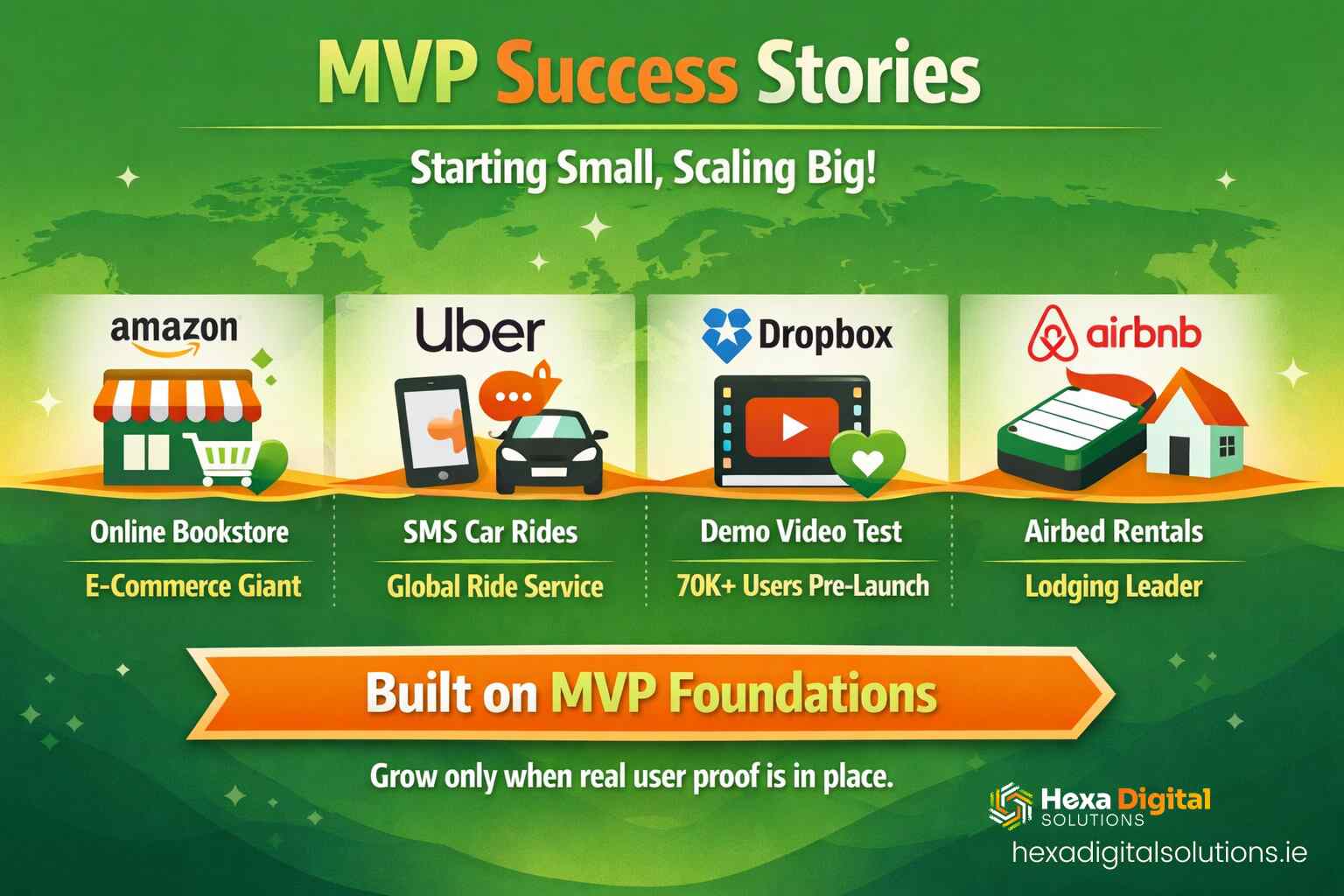
Start by spotting the core issue your product would solve. Amazon followed this rule because it launched solely as an online bookstore before growing into a global e-commerce marketplace, validating demand before expanding.
Step 2: Test Viability Before Expanding
Use idea validation to confirm feasibility on technical grounds, then introduce an MVP to ensure market need. Airbnb followed this approach in its initial phase by renting air mattresses through a simple website during a local conference, confirming customer interest before investing in a larger platform.
Step 3: Launch, Measure, and Improve
Launch only the critical features to a limited market segment and allow user response to determine the future development path. Dropbox deliberately validated demand with a demonstration video, attracting over 70,000 sign-ups before the final product was developed.
Following this order allows startups to manage risk, use resources efficiently, and provide solutions, such as Mobile App Development Services, aligned with authentic market needs rather than assumptions, creating a solid base for sustainable growth.
Where does Hexa Digital Solutions best fit?
Here is where Hexa Digital Solutions aligns organically. Hexa’s official site claims the company operates across website development, mobile app development, digital marketing, branding, and book publishing, making it a perfect fit for founders who are in search of more than just a coder on call.
For startups, it’s rare for an MVP to succeed solely in development. It also requires proper positioning, long-term trust, a clear identity, and a sound plan to reach the right market.
That is where an Irish mobile app development agency with Mobile App Development Services and digital branding solutions can provide assistance and guidance.
It is also where phrases like “What to Expect from Professional Digital Marketing Services“ and “A Look into the Digital Marketing Services Available Through Agencies“ stop feeling like brochure copy and start to mean something practical: launch support, target market testing, and feedback-focused implementation.
In the real world, that is how founders know how to take your brand to the next level with Digital Marketing Solutions, understand the impact of Digital Marketing on business growth, and get noticed fast with smart Digital Marketing services without wasting precious time on the wrong version of the product.
A lean model can even function like 6 Digital Marketing teams that help small Irish businesses scale, but with far less overhead and far more commitment.
Common Mistakes That Sink MVPs
Launching an MVP is about quick learning within controlled costs.
Some startups fail because they deviate from this purpose and invest time, money, and effort in features that have never received validation. Avoiding these common mistakes would significantly improve your chances of building a product that resonates with the market.
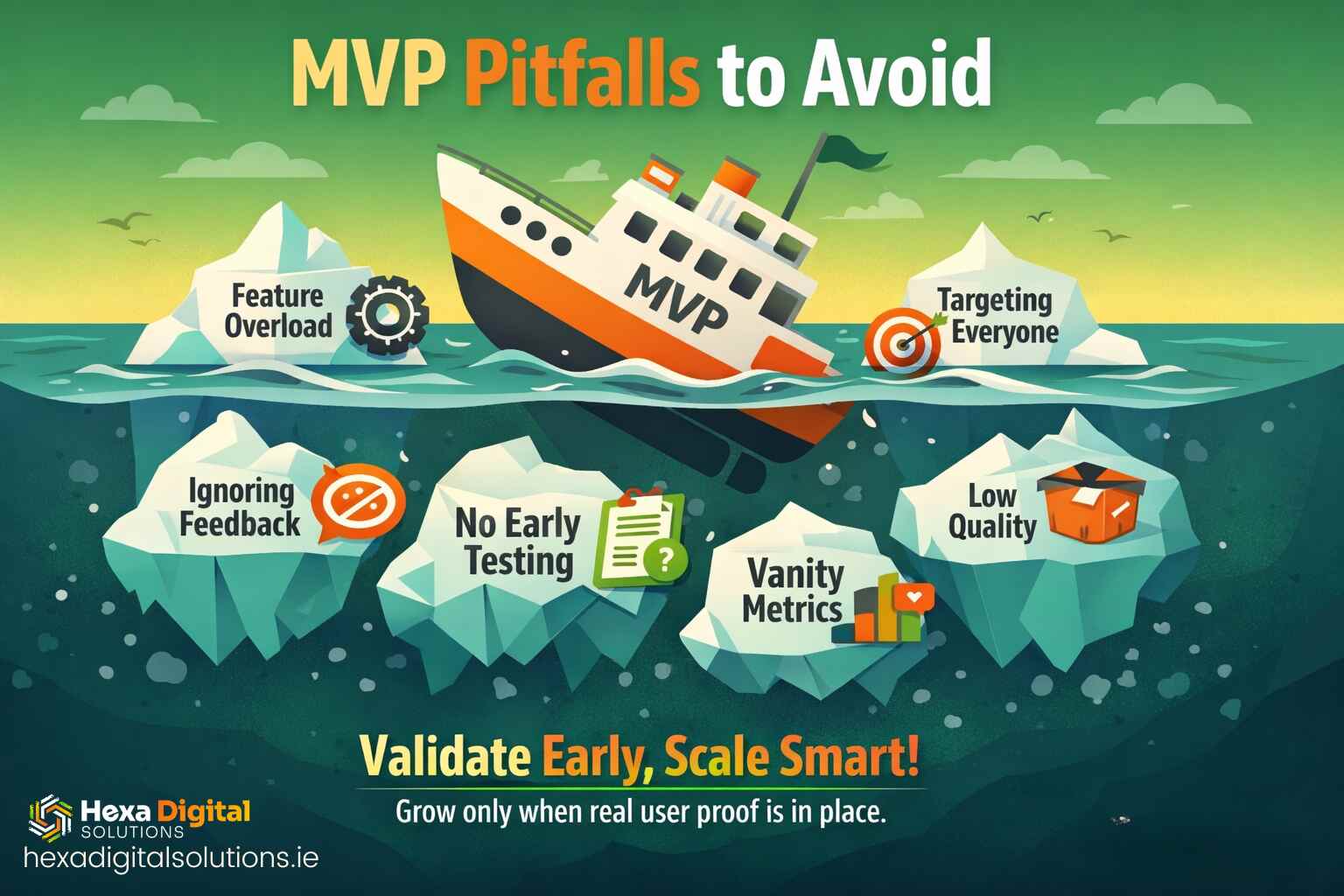
The most successful startups keep their MVP focused, learn from every release, and expand only when real user evidence supports the next stage of growth.
Conclusion
A startup MVP ensures quick learning, involves smart spending, and reduces the risk of failing. The best teams employ Mobile App Development Services to turn an idea into something practically relevant, then let users decide whether it deserves to stay and scale.
For founders seeking this balance between speed and discipline, Hexa Digital Solutions is here to provide services in this space.